
Orqenta — Bank-Grade Orchestration
Run critical workflows with absolute confidence. Orqenta is a next-generation orchestration engine that manages enterprise data and processes in a deterministic, auditable, and crash-safe manner.
What does it solve?
Problem
Critical workflows produce risks like dual-execution, missing steps, and data loss in distributed systems. In regulated sectors, these flaws lead to severe operational and audit risks.
Approach
Orqenta integrates disparate data pipelines and business processes into a single, automated orchestration layer — ensuring visibility, control, and reliability across the enterprise.
Business Value
Zero-loss crash recovery, secure retry mechanisms, and a full audit trail. Maximum reliability and compliance for high-stakes mission-critical operations.
When is it preferred?
- When precision and "exactly-once" execution are non-negotiable
- In industries requiring strict audit trails (Telecom, Banking, Energy)
- To eliminate split-brain risks and duplicate execution in distributed systems
- When processes must recover instantly and correctly after a system crash
- For managing complex dependencies with professional operational control
Note: Orqenta is designed specifically for regulated and high-compliance environments.
Core Capabilities
Deterministic execution
Managed dependencies and synchronization points for predictable flow management across distributed nodes.
3-Layer Idempotency
Prevention of duplicate effects using Event ID, Idempotency Key, and Execution ID for absolute correctness.
Crash-Safe Recovery
Database-driven state machine ensures full recovery without loss after any server or process interruption.
Operational Control
Professional management including pause, resume, cancel, node retry, and real-time agent rerouting.
Full Observability
Centralized logging, trace ID tracking, and dedicated execution incident management for rapid troubleshooting.
Bank-Grade Security
Built with RBAC, mTLS, HMAC authentication, SSRF protection, and automatic secret masking in logs.
Functional Design
High-level overview of Orqenta's reliability model and core execution capabilities, designed for long-running workloads in banking and telecom.
Deterministic Workflow Design
Visual DAG editor for complex cross-system synchronization and dependency management.
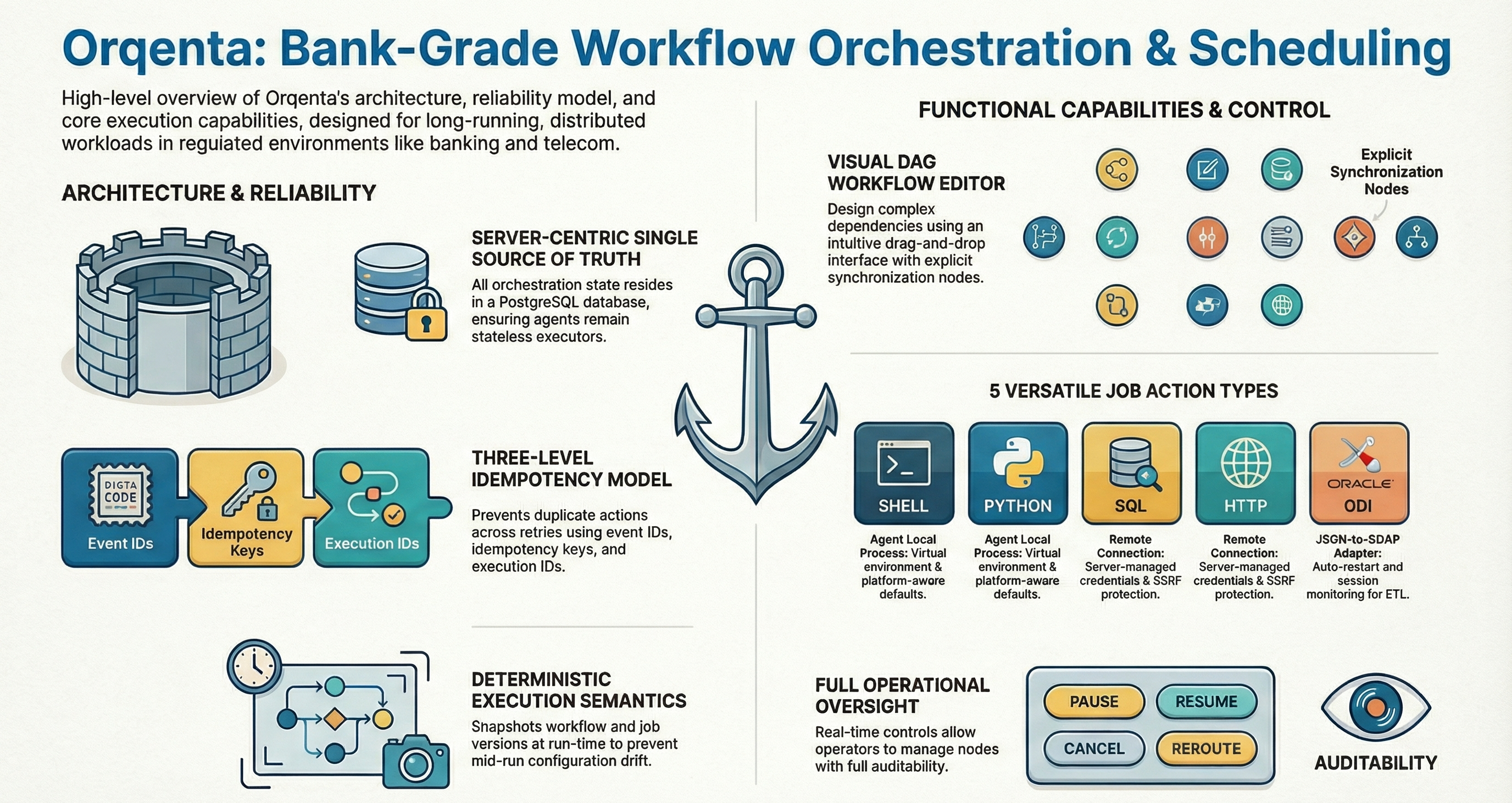
Orqenta Interface: Visualizing DAG workflow editing and operational oversight.
Strategic Use Cases
Orqenta manages critical dependencies and SLA targets to ensure predictable operational outcomes.
SLA Management in End-of-Day Batch Flows
When risk, accounting, or reporting steps in the end-of-day sequence delay, the entire chain is impacted, risking critical SLA breaches.
Orqenta Intervention
- Integrated model of complex cross-system dependencies.
- Define clear cut-off times and specific SLA targets.
- Real-time monitoring with automated escalations per delay.
BUSINESS IMPACT
- Guaranteed SLA compliance for regulatory reporting.
- Eliminated operational blind spots in batch cycles.
- Faster response to execution incidents.
DWH-to-BI Synchronization Dependency
Fragmented scheduling leads to BI refreshes triggering before DWH ETL processes are complete, resulting in dashboards displaying stale or incomplete data.
Orqenta Intervention
- Orchestrate DWH load, transform, and publish steps as a single DAG.
- Ensures BI refresh triggers only upon upstream ETL success.
- Self-healing mechanisms for automated retry of failed steps.
BUSINESS IMPACT
- 100% data reliability for executive dashboards.
- Standardized, predictable publishing cycles.
- Reduction in manual cross-team coordination effort.
Rating & Billing Chain Integrity
Mediation, Rating, and Billing must trigger in perfect sequence. Premature downstream execution results in incorrect billing and revenue leakage.
Orqenta Intervention
- Dynamic readiness checks for high-volume data files.
- Early warning signals for upstream bottlenecks.
- Automated escalation to prevent billing cycle delays.
BUSINESS IMPACT
- Minimized risk of revenue leakage and billing errors.
- Enhanced process synchronization across distributed nodes.
- Higher operational visibility for billing teams.
Critical Reporting Cut-Off Control
Utility reports require strict time-window management. Missing a cut-off due to data arrival issues leads to regulatory non-compliance.
Orqenta Intervention
- Strict enforcement of cut-off logic and time windows.
- Conditional triggers: block downstream if upstream quality thresholds are not met.
- Full audit trail for time-sensitive execution decisions.
BUSINESS IMPACT
- On-time regulatory reporting performance.
- Lowered risks of operational fines and audit failures.
- Robust, deterministic reporting governance.
Proactive Monitoring & Incident Control
Siloed process monitoring across tools increases issue detection time and extends Mean Time to Repair (MTTR).
Orqenta Intervention
- Integrated "single pane of glass" visibility for all enterprise flows.
- Early error signal detection with proactive alerting.
- Operational command: pause, resume, cancel, or reroute with full audibility.
BUSINESS IMPACT
- Reduced MTTR and minimized production outages.
- Significant gain in operational efficiency.
- Audit-ready incident management history.
Central Authority Model
Unlike traditional distributed schedulers, Orqenta centralizes decision logic to eliminate split-brain issues and out-of-sync states.
Stateless Agents
Execution agents pull tasks via HTTP polling, meaning zero inbound ports and easy network scaling.
State Machine
The state is managed entirely by a central database, ensuring every transition is atomic and durable.
Tag-Based Routing
Intelligent job routing based on labels, capabilities, or geographical constraints of execution agents.
Security & Governance
Orqenta is built for mission-critical enterprise environments requiring high reliability:
- RBAC: Granular permissions for Admins, Developers, Operators, and Viewers.
- Auth: mTLS or HMAC-SHA256 based agent authentication for secure communication.
- Protection: Built-in SSRF protection to prevent metadata leakage in cloud environments.
- Masking: Automatic redaction of secrets and credentials in logs and user interfaces.
Ready to Transform Your Data?
From data platforms to AI solutions, we help organizations turn data into measurable business value.