
IFDM — Finance Data Model
Rapidly deploy your enterprise finance data model. Establish a common financial language and accelerate your data warehouse transformation.
What does it solve?
Problem
Banking data is fragmented across core domains such as Loans, Deposits, Credit Cards, and Customers, managed in separate systems. This leads to inconsistent KPIs, reconciliation issues, and unreliable reporting.
Approach
IFDM integrates Loans, Deposits, Credit Cards, Customers, and Transactions into a single, standardized data model — ensuring consistent definitions, aligned reporting, and a true single source of truth.
Business Value
Provides a single source of truth for executives and decision-makers, enabling faster, more reliable, and audit-ready financial reporting with reduced reconciliation effort.
When is it preferred?
- When the enterprise finance model needs to be standardized during DWH/BI or analytics projects
- When there are inconsistencies between GL, AP/AR, budget, and profitability reports
- During Semantic model/Power BI transformation
- When consolidation and management reporting need to be made sustainable
- When a common dictionary and governance are targeted for finance KPIs
Finance-Specific Capabilities
Core Model
Provides finance assets and relationships in a standard framework.
KPI & Metric Framework
Provides a starting set for common finance metrics.
Analytical Layer Alignment
Tiering suitable for Power BI / semantic model designs.
Mapping & Adaptation
Rapid mapping approach for source system fields numbered to the model.
Governance & Standardization
Provides a foundation for versioning and standardization.
Extensible Architecture
Can be grown with new domains according to organizational needs.
Layered Architecture
IFDM structures fragmented finance data into business-meaningful subject areas. Our Foundation (3NF) and Analysis (Dimensional) layers ensure both enterprise data integrity and high-performance reporting infrastructure.
Standardized Methodology
Rapid mapping approach for source systems to an integrated enterprise data language.
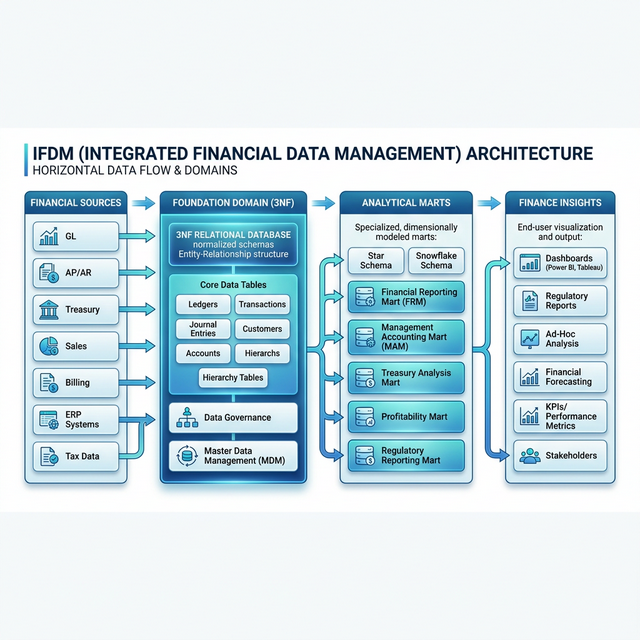
IFDM Architecture: Enterprise data standardization with Foundation and Analysis layers.
Business Value & Impact
Discover the value of IFDM in enterprise reporting and data management processes.
Accelerating Enterprise BI Transformation
In a new data warehouse project, designing the model from scratch extends the timeline, creates scope uncertainty, and increases redesign risk.
IFDM CONTRIBUTION
- Ready subject-oriented foundation model for the finance sector.
- Covers core domains like Party, Contract, Accounting, Product.
- Integrated 3NF structure according to Inmon principles.
- Ready metric and dimension structure for the analysis layer.
GAIN
- Project time is shortened.
- Modeling risk is reduced.
- Common data language between Business and IT.
Creating a Single Version of Truth
Different reporting teams using different data definitions lead to KPI inconsistencies and executive decision errors.
IFDM CONTRIBUTION
- Baseline business definitions and mapping structures.
- Integrated and normalized structure in the Foundation layer.
- Standard KPI and dimensional model in the Analysis layer.
- Conformed dimension approach for report consistency.
GAIN
- Single source of truth created across the organization.
- KPI inconsistencies eliminated.
- Increased executive reporting trust.
Implementation Journey
Scoping
Target reports, KPIs, and source systems are clarified.
Adaptation
Model adaptation is performed with mapping; the foundation layer is established.
Wave-based Rollout
Semantic layer and reports are deployed wave by wave.
Integration & Synergy
Our products are adapted to work seamlessly within your existing ecosystem. Typical integration areas include:
- ERP/Finance systems (SAP, Oracle, etc.)
- Databases & DWH layers
- ETL/ELT and orchestration tools
- BI and reporting platforms (Power BI, etc.)
- Identity and Access (SSO/LDAP) with role-based security
Ready to Transform Your Data?
From data platforms to AI solutions, we help organizations turn data into measurable business value.